 10/100BASE-T SFP
MDC UPC to MDC UPC Duplex Push-Pull Boot Uniboot OS2 Fiber Patch Cable
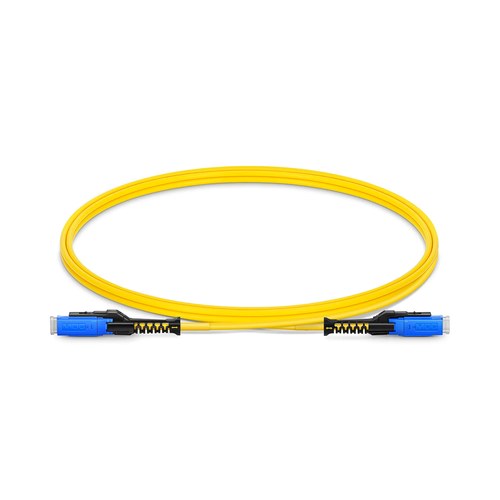
Singapore high-density designs should assess this item together with panel access, cable routing and the complete optical loss allowance. This OS2 fiber patch cable carries a MDC UPC interface on one end and a MDC UPC interface on the other, factory terminated on OS2 glass and optically tested as a full product. The uniboot structure places both fibers of the duplex channel inside a single round 2.0mm cord with one combined connector housing, halving this optical cable count in high-density panels and simplifying polarity management.
Product Highlights
- Uniboot Allows One Cable to Carry Two Fibers to Reduce Cable Congestion in High Density Patch Fields
- G.657.A1 & 10mm Min. Bend Radius
- 3x Fiber Cabling Density over Duplex LC, Providing 432 Fibers within 1 RU
- DirectConec™ Push-pull Boot for Effortless Connector Insertion and Extraction
- Simple Polarity Reversal with No Exposed Fibers
Specifications
| Connector A | US Conec MDC UPC Uniboot |
|---|---|
| Connector B | US Conec MDC UPC Uniboot |
| Insertion Loss | ≤0.3dB |
| Return Loss | ≥50dB |
| Fiber Mode | OS2 9/125μm |
| Wavelength | 1310/1550nm |
| Attenuation at 1310nm | ≤0.4dB/km |
| Attenuation at 1550nm | ≤0.3dB/km |
| Fiber Grade | G.657.A1 |
| Fiber Count | Duplex |
| Cable Outside Diameter (OD) | 2.0mm |
| Tensile Strength | (Long/Short Term) |
| Polarity | A (Tx) to B (Rx) |
| Operating Temperature | -10 to 70°C (14 to 158℉) |
| Storage Temperature | -20 to 70℃ (-4 to 158℉) |
Connector and polish choices in the single-mode plant
The OS2 interface on this jumper follows the polish discipline of the network it serves. Mixing polishes on a mated pair destroys the return loss and may damage the ferrules; consequently, the patch side must correspond to the patch panel side exactly. When the documentation is unclear, the boot color and this connector interface housing tell the truth: green for APC, blue or beige for UPC.
Bend tolerance in real cabinets
Patch fields are rarely kind to fiber. Leads pathway through tight managers, sharp tray corners and crowded vertical channels. The bend-insensitive glass in this terminated assembly tolerates a 10mm fiber bend radius; consequently, a hurried routing decision during a night upkeep window will not by itself turn into a measurable penalty on the channel.
One cord, two fibers
The uniboot design merges the duplex pair into a single round cord and a single connector housing. In a 400G row where every QSFP-DD port consumes a duplex channel, halving the cord count visibly changes the airflow and the manageability of the patching field.
Length Options
Standard cable lengths cover the common patching routes: 1m (3ft), 2m (7ft), 3m (10ft), 5m (16ft), 10m (33ft), 30m (98ft), 35m (115ft), 50m (164ft), 100m (328ft), with custom length obtainable beyond the list. Specifying the measured pathway length keeps the slack out of the manager and the strain off these optical interfaces.
Quality Control and Testing
Each completed assembly is terminated with precision zirconia ferrule connectors and optically tested before packing: insertion loss and return loss are verified on each cable, and end-face geometry is inspected for consistent physical contact. This optical cable ships with dust caps on both connectors and the test result obtainable on ask for.
Ordering and Factory Support
Refer to this arrangement by connector pair, fiber mode and length during the request for a quotation. For configurations outside the listed options, mixed connector families, jackets, marking or project packaging, send the requirement with the enquiry and the factory will review the build before manufacturing begins. Singapore and regional project orders can be reviewed for interface compatibility, packing details and delivery coordination.
