 10/100BASE-T SFP
LSH APC Simplex OS2 Fiber Adapter with Flange
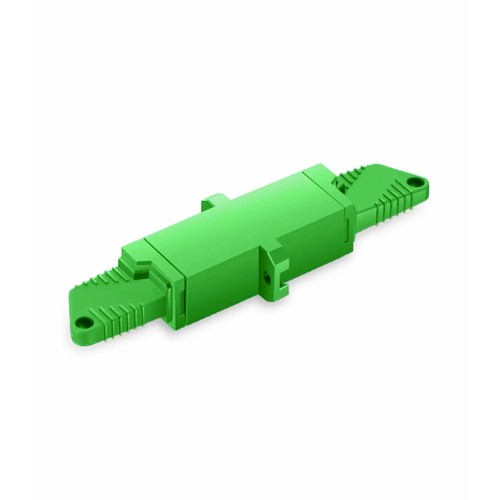
Singapore high-density designs should assess this item together with panel access, cable routing and the complete optical loss allowance. LSH APC Simplex OS2 Fiber Adapter with Flange couples two LSH connectors into one continuous optical channel. Inside the housing, a zirconia ceramic sleeve holds both ferrules on a common axis, keeping insertion loss low and consistent and repeatable across hundreds of mating cycles. The flanged housing screws directly to the patch panel cutout for a permanent, vibration-proof mounting.
Product Highlights
- ≤0.2dB(Typical) Low Insertion Loss
- Color Coded for Rapid Fiber Management
- Protective Dust Cap Keeps Adapter’s Interior Clean from Dust
- No Tools Required for Assembly
- Available in A Variety of Connector Types
Specifications
| Connector Type | LSH-LSH |
|---|---|
| Body Style | Simplex |
| Polish Type | APC |
| Fiber Mode | OS2 9/125μm |
| Insertion Loss | ≤0.2dB |
| Durability | 1000 times |
| Mounting Type | Full Flanged |
| Color | Green |
| Flammability Rate | UL 94V-0 |
| RoHS Compliancy Status | Compliant |
| Operating Temperature | -40 to 85℃(-40 to 185℉) |
| Storage Temperature | -10 to 60℃(14 to 140℉) |
| Connector loss? | by R***y on 11/28/2017 |
Why the alignment sleeve decides adapter quality
Every optical adapter is, at heart, a sleeve alignment problem: two connector ferrules must meet on one axis with their end faces touching, and any eccentricity shows up directly as insertion loss. Zirconia ceramic is the standard sleeve material for the reason that it machines to sub-micron tolerance, resists wear across repeated matings and holds its dimensions through temperature swings. The adapters in this range use zirconia sleeves rated for insertion loss of 0.2 dB or better, which keeps an adapter pair well inside any link loss budget.
Flanged and flangeless mounting compared
A flanged adapter fastens to the patch panel with two screws through the mounting ears: the joint is rigid, resists vibration and stays put for years, which suits frames and enclosures that move or ship. A flangeless adapter snaps into the cutout on spring latches: product is faster, density is higher, and a failed adapter swaps out in seconds without tools. Most panel families accept one style or the other; consequently, the selection follows the patch panel hardware already in the plant.
UPC and APC discipline at the adapter
The MMC adapter has no polish of its own, but it is where polish discipline succeeds or fails: mating a UPC connector to an APC connector through any adapter damages both end faces and wrecks return loss. Color coding exists to prevent exactly that - green housings for APC, blue for UPC single-mode - and the discipline only works when the whole plant follows it. Keep the MMC adapter color, this connector interface boot color and the documentation consistent, and the mixing mistake becomes nearly impossible.
What adapter testing actually measures
Because an adapter contributes no signal of its own, its test is a mating test: reference connectors mate through the MMC adapter, and the inserted loss is recorded. A zirconia-sleeve adapter should add no more than 0.2 dB, and the mating must repeat that figure across cycles. Durability testing runs the mating hundreds of times and re-measures - a sleeve that wears loose announces itself as creeping loss. These figures, not the housing color, are what separates an adapter that serves for years from one that becomes the mystery fault.
Selecting the right adapter for the panel
Five decisions define the MMC adapter order: this connector interface pairing must correspond to both sides of the mating, the mounting style must fit the patch panel cutout, the polish color code must correspond to the plant, the sleeve material must suit the performance grade, and the count must cover the load-out plus spares. Getting all five right at order time is what turns a bag of couplers into a dependable panel. Where the pairing crosses connector families, the hybrid range covers the common conversions.
Quality Assurance and Factory Testing
Every adapter is inspected before packing: the sleeve bore is checked for alignment and surface finish, the housing latches are cycled for positive engagement, and sample matings from each production lot are measured for insertion loss. Accessories are checked for fit against the adapters they serve. In Singapore facilities, this check should form part of the rack-access and acceptance review.
Quotation and Factory Support
Refer to this adapter by connector pairing, mounting style, polish grade and pack quantity during the request for a quotation. For configurations outside the listed options - mixed packs, panel hardware kits or project packaging - send the requirement with the enquiry and the factory will review the manufacturable specification. Singapore and regional project orders can be reviewed for interface compatibility, packing details and delivery coordination.
